
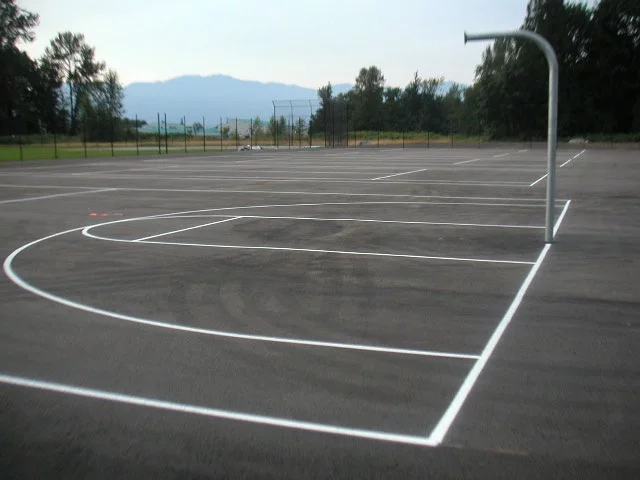
A cracked, faded, or uneven sport court doesn’t just look tired, it can genuinely affect play quality and safety, whether it’s a backyard basketball hoop, a community tennis court, or a full facility with multiple courts in regular use. Resurfacing is often a far more cost-effective solution than a complete rebuild, but it’s a specialized service that not every paving contractor actually offers. As one of the few concrete contractors in the Lower Mainland that provides dedicated sport court resurfacing, here’s what homeowners and facility managers should know before starting a project.
Why Sport Courts Need Specialized Attention
Unlike a standard driveway or patio, sport courts have specific performance requirements: consistent surface levelness, proper drainage, and surface texture calibrated for ball bounce and player traction. A resurfacing job that doesn’t account for these factors can leave you with a court that looks fine but doesn’t actually play well, which defeats the purpose of the investment in the first place.
Signs Your Court Needs Resurfacing
A few common signs indicate it’s time to consider resurfacing rather than continuing to patch individual problem areas:
Visible cracking, particularly cracks that have started to spread or multiply over time, which can worsen with each freeze-thaw cycle if left unaddressed.
Uneven surface areas where water pools after rain, which not only creates a safety hazard but also indicates deeper structural issues with the base beneath the surface.
Faded or worn playing lines, particularly on courts that see heavy regular use, where line visibility affects how well the court can actually be used for organized play.
Inconsistent ball bounce, a sign that the surface texture and levelness have degraded to the point where it’s affecting actual gameplay, not just cosmetic appearance.
Tennis Court Resurfacing in BC: What’s Involved
Tennis court resurfacing in BC typically involves several stages: repairing any structural cracks or base issues first, applying leveling and patching compounds to address uneven areas, installing a new surface coating calibrated for proper ball bounce and player traction, and repainting playing lines to precise regulation specifications. Given how much rain the Lower Mainland receives throughout the year, proper drainage consideration is especially important in tennis court resurfacing here, since standing water can quickly undermine even a freshly resurfaced court if drainage wasn’t addressed as part of the project.
Basketball Court Paving: Residential and Facility Considerations
Basketball court paving needs differ depending on whether you’re working on a backyard half-court or a full facility court. Residential courts generally prioritize a durable, low-maintenance surface that holds up to occasional use and BC’s wet climate, while facility courts serving regular organized play need more rigorous surface calibration for consistent ball bounce and player safety across heavy, repeated use. Both applications benefit from proper base preparation and drainage planning, which matters just as much for a backyard half-court as it does for a full regulation facility.
Backyard Sport Court Contractor: What to Look for
If you’re a homeowner considering a backyard sport court contractor for resurfacing or new installation, a few factors matter beyond general paving experience. Look for a contractor with specific sport court experience, not just general driveway and patio work, since the performance requirements are genuinely different. Ask about drainage planning specifically, given how much this affects long-term durability in our climate. And request examples of completed sport court projects, since this is a more specialized niche than standard residential paving work.
Resurfacing vs. Full Rebuild: Making the Right Call
Not every court in poor condition needs a complete rebuild. If the underlying base and structure are still sound, resurfacing can address surface-level cracking, unevenness, and wear at a significantly lower cost than starting from scratch. However, if the base itself has failed, evidenced by significant structural cracking, major drainage failures, or extensive settling, a full rebuild may ultimately be the more cost-effective long-term solution, even though it carries a higher upfront cost than resurfacing alone.
What the Resurfacing Process Typically Involves
A thorough sport court resurfacing project generally follows a structured process: an initial assessment of the existing surface and base condition, repair of any structural issues before surface work begins, proper leveling and patching to address unevenness, application of the new surface coating, and precise line painting to regulation or custom specifications depending on the court’s intended use.
Why Drainage Planning Matters So Much in Our Climate
Given how much rain the Lower Mainland receives throughout the year, drainage is one of the most important, and most commonly overlooked, factors in sport court longevity. A court resurfaced without addressing underlying drainage issues may look great initially but can develop new problems within just a season or two as water finds its way back into areas that weren’t properly addressed during the resurfacing process.
Why Few Contractors Offer This Service
Sport court resurfacing requires specialized knowledge of surface coatings, drainage planning, and precise leveling that falls outside the scope of standard residential paving work, which is exactly why few contractors in the Lower Mainland offer it as a dedicated service. This gap is part of what led us to build out sport court resurfacing as a core part of our offering, rather than treating it as an occasional side project.
Real Client Experiences
Homeowners and facility managers who’ve worked with us on sport court projects consistently mention the difference proper drainage planning and surface calibration make compared to a standard paving approach applied to a sport court without those specific considerations. You can read more about these experiences in our client testimonials.
Why Choose Bortolo & Sons for Sport Court Resurfacing
With more than 50 years of experience in asphalt and concrete paving throughout the Lower Mainland, our team brings the specialized expertise sport court resurfacing genuinely requires, from proper drainage planning to precise surface calibration for consistent play quality.
Frequently Asked Questions
How often does a sport court need resurfacing? This varies based on usage and climate exposure, but many courts benefit from resurfacing every 8 to 12 years, sooner if drainage issues or heavy use accelerate wear.
Can a backyard basketball court be resurfaced, or only full facility courts? Yes, backyard courts can absolutely be resurfaced, though the process and priorities differ slightly from a full facility court given typically lighter, more occasional use.
How long does sport court resurfacing typically take? Timelines vary based on court size and condition, but most residential sport court resurfacing projects can be completed within a few days to a week.
Does resurfacing fix drainage problems on an existing court? It can, if drainage issues are addressed as part of the resurfacing process itself. Simply applying a new surface coating without addressing underlying drainage will likely lead to the same problems resurfacing again in the near future.
Is resurfacing cheaper than a full court rebuild? Generally yes, provided the underlying base and structure are still sound. If the base has failed, a full rebuild may ultimately be the more cost-effective long-term choice despite the higher upfront cost.
Ready to bring your sport court back to top playing condition? Request a free quote and let’s talk through your court’s specific resurfacing needs.