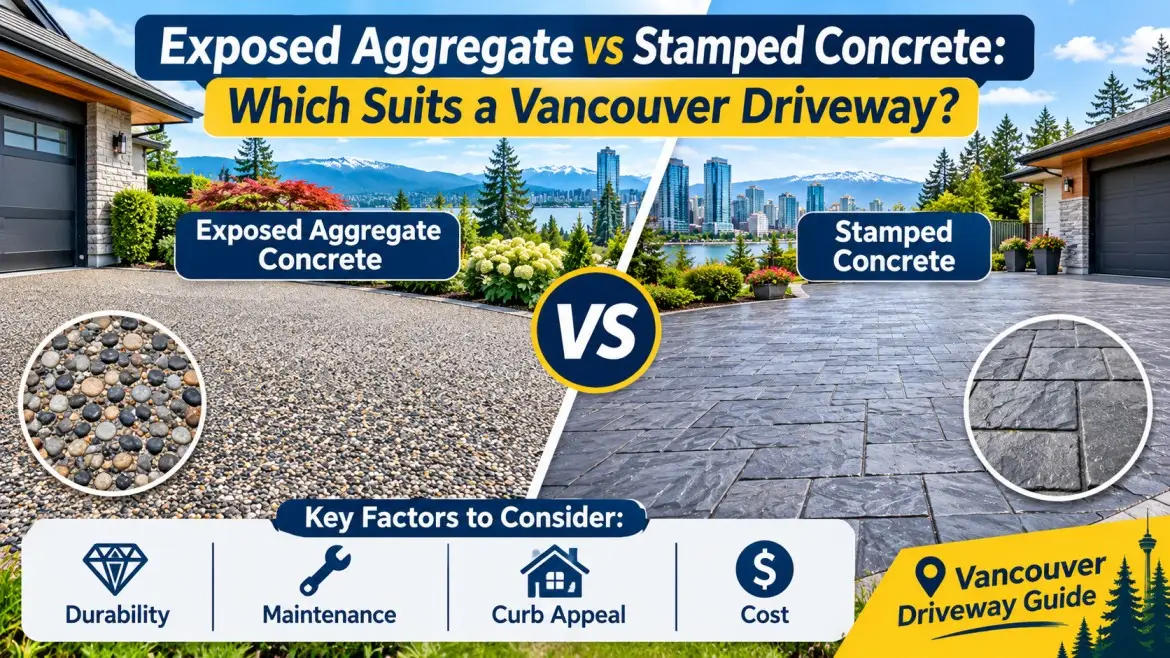
Quick answer: exposed aggregate or stamped concrete?
Choose exposed aggregate if you want a textured, naturally slip-resistant driveway that hides dirt well, at about $13 to $18 per square foot. Choose stamped concrete if you want the look of stone, brick or slate, at about $16 to $25 per square foot, and plan to reseal it regularly with a slip-resistant additive.
Both are decorative concrete. Both are poured new, both can be coloured, and both can last for decades when the base under them is built properly. The difference is in how they look, how they feel underfoot on a wet November morning, and how much care they need over the years. This guide puts the two side by side for homeowners in Vancouver and Burnaby.
Side-by-side comparison
| Feature | Exposed aggregate | Stamped concrete |
|---|---|---|
| Look | Natural stones showing at the surface; speckled, textured finish | Pressed pattern that copies stone, slate, brick or tile, often in one or two colours |
| Traction in rain | Naturally slip-resistant because of the exposed stone texture | Smooth sealed surfaces can get slippery; a slip-resistant additive in the sealer helps |
| Maintenance | Sweep, rinse and reseal every two to three years | Sweep, rinse and reseal every two to three years to protect colour and pattern |
| Repairs | Patches are easier to blend into a speckled surface | Repairs are harder to hide because the pattern and colour must match |
| Cost (Bortolo published prices) | $13–$18 per sq ft | $16–$25 per sq ft |
| Best for | Steep or shaded driveways, walkways, stairs and busy entrances | Homeowners who want a specific pattern or a high-end, stone-look finish |
Neither finish is “better” in every case. The right choice depends on your slope, how much shade the driveway gets, the style of the house and how much upkeep you’re happy to do.
What each finish is, in plain terms
Exposed aggregate
Concrete is a mix of cement paste, sand and stone. With exposed aggregate, the top layer of paste is removed while the concrete is still setting, so the stones underneath show through. The result is a rough, pebbly surface with natural variation in colour. You can read more about how we install it on our custom concrete driveway page.
Stamped concrete
Stamped concrete is poured as normal, then textured mats are pressed into the surface before it hardens. Colour is usually added to the mix or the surface, and a release agent can add a second tone. The finished slab looks like stone, slate or brick without the joints that let weeds grow between pavers. If you’re choosing a pattern, our guide to stamped concrete patterns and colours walks through the options.
What each finish costs in Vancouver and Burnaby
Bortolo and Sons publishes its decorative concrete prices, which gives you a fair starting point:
- Exposed aggregate: $13 to $18 per square foot
- Stamped concrete: $16 to $25 per square foot
- Coloured concrete: $12 to $25 per square foot
For comparison, the HomeStars Vancouver concrete contractor cost guide lists a standard concrete driveway at $12 to $16 per square foot and a stamped driveway at $18 to $26 per square foot.
A worked example: a 600 sq ft driveway
Take a typical two-car driveway of about 600 square feet:
| Finish | Price per sq ft | Approximate total for 600 sq ft |
|---|---|---|
| Exposed aggregate | $13–$18 | $7,800–$10,800 |
| Stamped concrete | $16–$25 | $9,600–$15,000 |
These totals are simple multiplications and cover the finished surface only. Removing an old driveway, rebuilding a soft base, adding drainage and any City work at the street crossing are extra. For the full picture, including asphalt and plain concrete, see our 2026 driveway cost guide for Vancouver and Burnaby.
Why stamped concrete usually costs more
Stamping takes more labour. The crew has to press the mats in a short window while the concrete is workable, line up the pattern across the whole driveway and apply colour evenly. More colours, borders and detailed patterns add time. Exposed aggregate also needs skilled timing, but there is no pattern to align, so the price range sits lower.
Which finish suits your lot?
The ground, the shade and the style of your home matter as much as the price. Here’s how the two finishes compare on the kinds of properties we see across Vancouver and Burnaby.
Steep driveways
On sloped lots, traction comes first. Driveways on Capitol Hill, Burnaby Mountain and the North Shore are wet for much of the year, and a smooth sealed surface on a slope can be hard to walk on. Exposed aggregate has grip built into the surface, which is why many homeowners on steep lots choose it. If you prefer stamped concrete on a slope, ask for a deeper texture and a slip-resistant additive in the sealer.
Shaded lots and moss
Mature trees in neighbourhoods like Dunbar and Kitsilano keep driveways damp and shaded, and moss and algae grow quickly on damp concrete. Exposed aggregate hides staining and wear well, and its texture still gives some grip when the surface is damp. Stamped concrete can look striking under trees, but plan on regular cleaning and resealing to keep it looking its best and to keep the surface safe.
Entrances, walkways and stairs
Front steps, landings and entry paths take daily foot traffic in all weather. Exposed aggregate is a common choice here because of its grip and the way it hides dirt. Our concrete patios and walkways page covers the options for paths and outdoor living areas.
Character homes vs modern homes
Stamped concrete patterns such as cobblestone, slate or brick can suit traditional and character homes, where a stone look fits the architecture. Exposed aggregate has a natural, understated look that works with modern West Coast homes as well as older ones. If you’re unsure, bring photos of your house to the estimate and ask to see samples of both.
Using both on one driveway
You don’t have to choose one. A popular approach is an exposed aggregate field with a stamped or coloured border. You get the grip and low-key look of aggregate on the main surface, and a finished, decorative edge where the driveway meets the walkway or the street. It also keeps the more expensive stamped work to a smaller area.
Real projects: what each finish looks like in practice
Exposed aggregate: Larch Street, Vancouver
At an apartment building on Larch Street in Vancouver, the project was a complete demolition and reconstruction of the entrance landing, staircase and retaining walls, with an exposed aggregate entrance stairway. It’s a good example of where aggregate shines: a busy entrance and stairs that residents use in every kind of weather. See the exposed aggregate entrance stairway at 1960 Larch Street.
Stamped concrete: Coquitlam driveway
For a homeowner in Coquitlam, we installed a stamped and coloured concrete driveway to lift the home’s curb appeal with a custom pattern. See the stamped concrete driveway project in Coquitlam.
Looking after your decorative concrete
Good care keeps either finish looking sharp for years:
- Reseal every two to three years. Sealer protects the colour and surface from water, oil and wear. For exposed aggregate, our step-by-step guide on how to seal exposed aggregate concrete explains the process.
- Ask for a slip-resistant additive in the sealer on stamped concrete, especially on slopes and walkways.
- Sweep and rinse regularly. Leaves and needles hold moisture and encourage moss.
- Skip the rock salt. Use a concrete-safe de-icer in winter instead.
- Clean oil and stains early before they soak in.
With proper installation and resealing every few years, a stamped concrete driveway typically lasts 25 years or more. Exposed aggregate is plain concrete underneath, so the same base and drainage work decide how long it lasts.
Questions to ask before you choose a finish
A good estimate should help you decide, not just quote a price. Before you sign, ask:
- Can I see samples of both finishes? Photos rarely show texture. Seeing and touching a sample tells you how rough the aggregate is and how deep the stamp pattern goes.
- How will the surface handle my slope? On a steep driveway, ask how traction will be managed: exposed stone, a deeper stamp texture, or a slip-resistant additive in the sealer.
- What happens to the base? Decorative finishes only last if the gravel base underneath is solid and well drained. Ask how deep the excavation will be and how the base will be compacted.
- How is water directed away? Ask where runoff will go, especially near garages, lanes and the street crossing.
- What sealer will you use, and when should I reseal? You should leave knowing the resealing schedule and how to care for the surface in winter.
- Is any City approval needed? If the project changes the width of the driveway or the crossing at the street, City approval may be needed before work starts.
Clear answers to these questions are a good sign that the finish you choose will look good and perform well for years.
Upgrading an existing driveway
If you already have a concrete driveway, it can’t simply be stamped. Stamped concrete has to be pressed while freshly poured, so the old slab must be removed and a new one poured. The same applies to exposed aggregate. If you have an asphalt driveway in good condition, stamped asphalt can be applied over it as a lower-cost decorative option. For a full new driveway in plain or decorative concrete, see our concrete driveway installation service.
Frequently asked questions
Is exposed aggregate or stamped concrete better in Vancouver rain?
Exposed aggregate usually handles rain better because the exposed stone gives natural grip, even on wet days. Stamped concrete is smoother once it’s sealed, so it can get slippery on slopes and walkways. If you choose stamped concrete, a slip-resistant additive in the sealer helps a lot, especially on steep Vancouver and Burnaby driveways.
Which costs less, exposed aggregate or stamped concrete?
Exposed aggregate costs less. Bortolo and Sons publishes exposed aggregate at $13 to $18 per square foot and stamped concrete at $16 to $25 per square foot. For a 600 square foot driveway, that’s roughly $7,800 to $10,800 for aggregate and $9,600 to $15,000 for stamped, before removal, base work or City approvals.
How long does a stamped concrete driveway last?
With proper installation and resealing every few years, a stamped concrete driveway typically lasts 25 years or more. The base under the concrete matters most, followed by drainage and regular care. Resealing every two to three years protects the colour and pattern from water, oil and wear in our wet Lower Mainland climate.
Can I stamp my existing concrete driveway?
No. Stamped concrete has to be pressed while the concrete is freshly poured, so an existing slab can’t be stamped. You would need to remove it and pour a new driveway. If you have a sound asphalt driveway, stamped asphalt can be applied over it instead, which is a lower-cost way to add a decorative look.
Can I combine exposed aggregate and stamped concrete?
Yes, and it’s a popular choice. Many homeowners pour an exposed aggregate main surface for grip and low upkeep, then add a stamped or coloured border along the edges or at the entrance. It gives a finished, custom look while keeping the more expensive stamped work to a smaller area of the driveway.
Get a decorative concrete estimate
Bortolo and Sons Paving Co. Ltd. is a family-owned paving and concrete contractor based in Burnaby, building driveways across the Lower Mainland since 1974, from Vancouver to Burnaby. We’ll show you samples of both finishes, check your slope and drainage, and give you a clear written price. Request your free decorative concrete estimate.